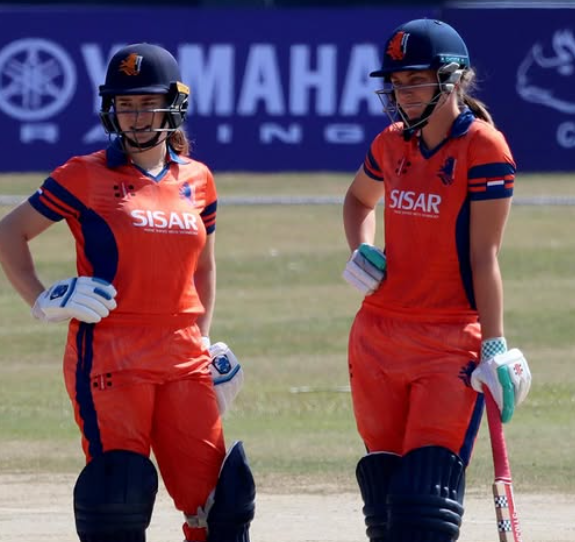
Robin Rijke and Babette de Leede: Why the ETPL Matters Beyond the Boundary

For the Netherlands women’s cricket team, the arrival of the ETPL represents an opportunity that extends beyond the men's game. While the ETPL is currently a men's competition, Netherlands internationals Robin Rijke and captain Babette de Leede believe the tournament can play an important role in introducing cricket to new audiences and encouraging more young people across the country to pick up a bat and ball.
Cricket may have a proud history in the Netherlands, but it remains far from the country's biggest sporting attraction. That makes visibility particularly important, and Rijke believes the ETPL can provide exactly that.
"We're really hoping that a lot of people will come to the games and still people don't know cricket in the Netherlands. We hope that people can see this and see the quality and the thrill of the game that we love so much and, yeah, let's hope that people want to join as well," said Rijke, an all-rounder for the Netherlands.
The opportunity, therefore, is not simply about filling the stands. It is about allowing people who may never have watched high-level cricket to experience the speed, skill and excitement of the T20 format first-hand.
For Babette de Leede, the potential impact goes even further.
As captain of the Netherlands women's team, she understands the importance of creating a strong pathway for the next generation. For cricket to grow sustainably, she believes young boys and girls need opportunities to discover the sport early and feel that there is a place for them within it.
"I think it's very important for cricket in the Netherlands that it keeps growing. We keep getting especially girls and boys to play from a very young age to grow the game, to get more people involved," de Leede said.
That makes the ETPL an interesting addition to the Dutch sporting landscape. The visibility generated by the competition can potentially benefit the wider game creating more awareness, attracting new supporters and encouraging children to become involved in cricket.
De Leede also expects the quality on the field to make an impression.
"I think this is a great initiative and I think that the quality of the games will be really good, will be very exciting, so we're looking forward to this ETPL to start," she said.
And the support will not remain theoretical.
With the Netherlands women's team scheduled to travel to Scotland for their own international commitments, the players will have a busy period ahead. Yet de Leede confirmed that the team would still make time to experience the ETPL themselves.
Asked whether they would attend matches whenever they were in the Netherlands, her answer was immediate.
"Yeah, we'll be there this Wednesday."
That willingness to engage with the tournament captures the wider opportunity.
The ETPL may currently be a men's competition, but cricket does not grow in isolation. Every new spectator matters. Every child inspired to try the sport matters. Every family that discovers cricket matters. And as the league grows, the possibility of a women's format in the future could open up another exciting pathway for the next generation of European cricketers.
For the Netherlands, the arrival of the ETPL can therefore become about more than the players on the field. It can be about making cricket more visible, more accessible and more exciting for the next generation, girls and boys alike.