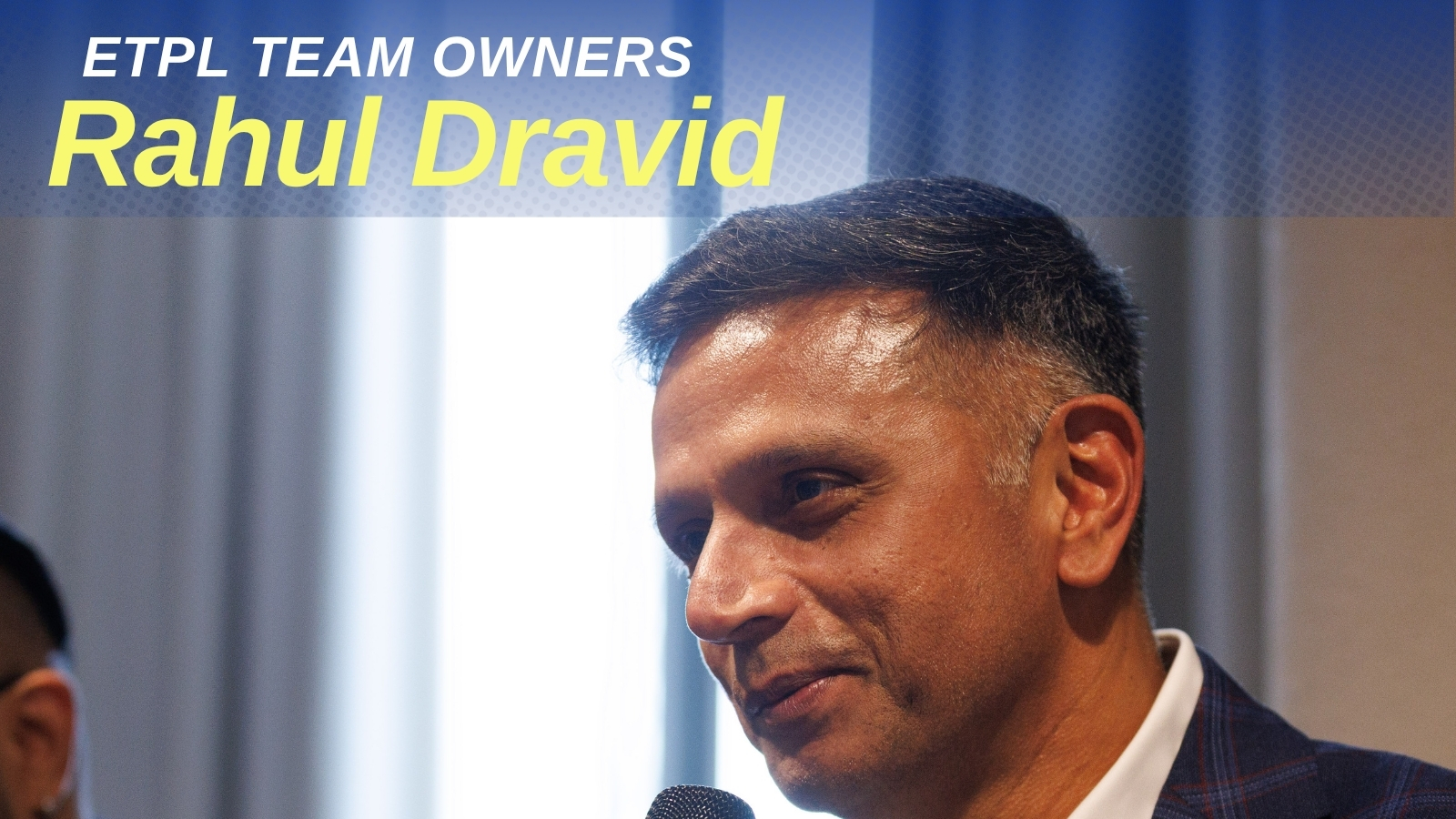
From World Champion to Continental Builder: Dravid's Next Chapter in Europe

Rahul Dravid is one of the greatest batsmen cricket has ever produced. When the conversation turns to technique, temperament and the ability to bat time in the most demanding conditions the game can offer, Dravid stands at the summit.
He made his debut for India in 1996 and spent the next sixteen years accumulating one of the most decorated batting records in the history of the game, 24,177 runs and 48 centuries. A batting average that tells only part of the story, because the fuller story is about the situations those runs came in, the pitches they came on, and the teams they rescued.
He carried India in England, in Australia, in the West Indies, in conditions that everyone around him usually struggled in.
What separated Dravid was never just talent, it was curiosity. A restless desire to understand the game in every form, in every condition, on every surface. That curiosity took him, in 2003, to Scotland, where he represented the nation in the National Cricket League, scoring three centuries in eleven games. It was a detour that told you everything about the man: here was one of the finest batsmen in the world, voluntarily testing himself in unfamiliar territory, not for headlines, but because the challenge itself was worth something.
He was also, quietly, one of the finest slip fielders of his generation, and a wicketkeeper when India needed one, though he wore that particular burden with characteristic stoicism rather than enthusiasm. He captained India in 79 internationals, and when he did, he led the way he batted: with method, calm, and an unshakeable sense of what he was trying to build.
When he retired from international cricket in 2012, the tributes came from everywhere, from opponents who had spent careers trying to dislodge him and never quite managed it.
Rahul Dravid's story did not end at retirement. If anything, the second chapter revealed something the first had only suggested: that his greatest gift was not just the ability to bat, but the ability to think about batting, and about cricketers, with unusual clarity and patience.
The transition did not happen overnight. Towards the end of his playing career, Dravid had already begun to find his footing as a leader in the IPL with Rajasthan Royals, where he served as captain from 2011 to 2013 before stepping into a mentoring role. It was there, in the franchise environment, that his instinct for developing players and building team culture began to take a more deliberate shape.
Following which, Dravid mentored and coached India A and Under-19 setup, where his influence on a generation of players became quietly transformative. He guided the Under-19 side to the World Cup final in 2016 and then to the title itself in 2018, producing a generation of players, the likes of Rishabh Pant, Shubman Gill, Ishan Kishan and Arshdeep Singh among them.
In 2021, he took on the role of head coach of the senior Indian men's team, a position he held through a period of significant transition. His tenure was defined by the same qualities that had defined his batting: methodical preparation, a refusal to panic, and a deep belief in process over outcome. He stepped down from the role in 2024 after India's T20 World Cup victory, leaving on his own terms, as a World Champion.
His connection to the architecture of cricket runs so deep that it is almost impossible to imagine the modern game without his fingerprints somewhere on it. For all the institutional weight he carries, Dravid has never seemed interested in status for its own sake. What has always driven him is the craft, the problem of making a player better, the challenge of building something that lasts.
Which is perhaps why, when Abhishek Bachchan and the ETPL came calling, the conversation did not take long. In 2026, Dravid joined the league as co-owner of the Dublin Guardians, bringing to European cricket a mind that has spent three decades studying the game from every possible angle. It felt less like a business decision and more like a natural extension of everything he has always believed in.
At the Dublin announcement, he spoke about what drew him to the project with the same quiet conviction that once made him impossible to dislodge at the crease. "So many World Cups have really shown us the ability and the talent that is available in Europe," the 53-year-old said. "It is something that we can build on. That has really been exciting for me, to be involved with something at this stage, to be able to grow and build cricket in the continent."
As a batsman who mastered the longest format, as a coach who shaped the shortest, and as a leader who always understood that culture precedes results, Dravid arrives in Europe not as a figurehead but as a builder. His career has shown us that when Rahul Dravid commits to something, he does not stop until it is done properly.